
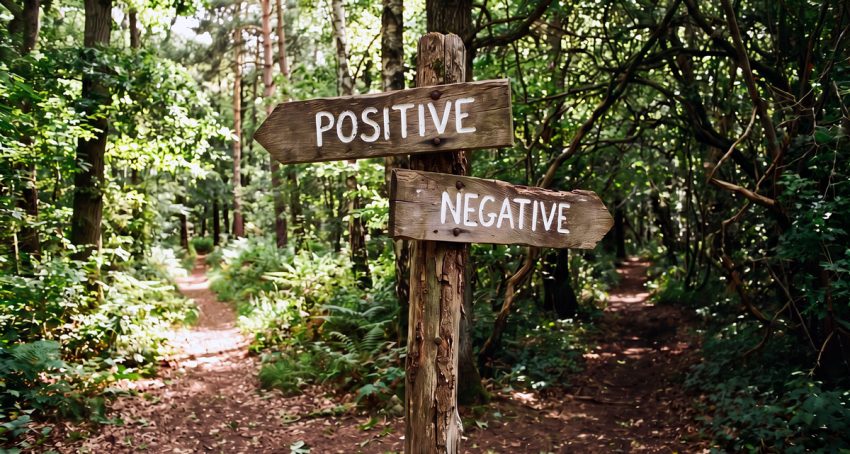
In The Negative Trying NOT to do things is NOT productive
Estimated reading time: 8 minute(s)
A long time ago, when our two oldest boys were young, someone asked one or both of them if we had a family slogan. I don’t recall the context (I should ask them), but I do recall their answer. The first thing that came to mind for them was: “We don’t do that.” Ha! The words that they thought—felt—that we lived by were completely restrictive and negative.
Maybe they were.
That wasn’t the point, and really, at the time (and even now) the only thing I can really think of that would have shaped that would have involved consuming pop culture. We usually did not watch movies that “everyone else” watched, and definitely not TV shows (the only ones we watched were from the 1980s), and we didn’t usually listen to the radio (so no current music, although that one was circumvented by Mom when Alex relentlessly pestered her into playing the radio in the van on their weekly paper route trips.. which likely led to more times when the kids were with just Mom).
There were other things, I suppose, too. Things I wouldn’t even think we were saying (in as many words) “we don’t do that” to. Jen and I have chosen to disregard alcohol. It has no appeal to us, and there are so many reasons to avoid it, it’s just not part of our world in any way. This may have formed itself into a “we don’t” as our kids interacted with the world around them. (Including, or especially through screens.)
Then, a very long time ago, I saw the folly in what our culture calls “dating” and wanted no part of that. Jen and I aligned (mostly?) on our thoughts on that and began teaching a course to young adults titled One Man, One Woman about God’s design for the most intimate of all relationships. From that, very counter-culturally, we don’t acknowledge the terms “boyfriend” and “girlfriend” (maybe mostly me, but that probably became a “we don’t” in our home) because there is no true equivalent to those concepts in God’s design. This was such a strong truth in our home that Alex led his siblings in creating a word for those not-spoken words so that they could still reference those cultural ideas without using the non-sanctioned words. Boyfriend was “Bleep”, and girlfriend was “Bleepity” (because it’s longer).
Add to that the fact that, as ones who live life in Jesus but don’t align ourselves with any particular Church With a Name (which includes not attending any Sunday morning gatherings), there were many times any one of us would have to say something at least along the lines of “we don’t do that” to a curious or argumentative church goer.
“We don’t do that” apparently was our mantra.
Today I noticed that I really don’t like that.
Lately I have been feeling very constricted by it. There are things I would say or do that I end up not doing because when I do, they are consistently being frowned upon or ridiculed, or flat-out demanded to be stopped. To me, they are natural, and not bad, only good. But I am being told they are—and by extension, I am—only bad.
Is this how my kids felt growing up?
Focus On Good, Not Avoiding Bad
A very long time ago, before I was married, I remember that I often dealt with what I felt was lust. I would see a beautiful woman and have sexual thoughts about her. Thinking back on it, I was likely overreacting. But, I was young, and hormones are real, and it frustrated me that I could not “control” it. (I have written a few songs about this struggle.) As I worked through this with God, I realized—likely with the gentle and direct help of Holy Spirit—that I was able to live more freely in this realm when my life was so full of good that I didn’t even notice the bad. Meaning, when I stopped trying to not, I didn’t even think about what I was trying to not do. I was focused on doing good, not not doing bad.
Being a campus minister at the time, I began sharing this truth with our college groups, teaching them to focus on the good (doing good things in the world) rather than limiting/stopping the bad. I think this is what Paul meant by what he wrote in Philippians 4:8-9
And now, dear brothers and sisters, one final thing. Fix your thoughts on what is true, and honorable, and right, and pure, and lovely, and admirable. Think about things that are excellent and worthy of praise. Keep putting into practice all you learned and received from me—everything you heard from me and saw me doing. Then the God of peace will be with you.
He doesn’t say, “Make sure you don’t do …” (although he does in some other places—there are obviously things to avoid, that hurt us and others1) he only says, essentially, focus your mind (your self) on good, and do that.
Parenting is Different
I know that I also taught this to my children. I remember, especially as they were getting older, that I repeatedly reminded them that it’s always better to go toward something good than to go away from something bad. Even as I type that now, I realize that in this broken world, there are certainly things that we need to just get away from2. But I do think it is still superior to go toward something that is good (the action being positive) than to have the impetus for action being a negative.
And I think recently I am feeling the life-dampening effects of living the negatives.
Lately, in choosing for those around me (that’s the positive spin), I am frequently living my own “no”. Something I would choose to do (for good) is not an option for those around me, and so it becomes a collective “we don’t do that”. Whether it is how we spend our time, money, or selves, it is not only not agreed upon, it is a “no”—and so, in effect I end up feeling that I am being told I am a “no”. That is wearying.
As I reflect on this, I am still not sure that I ever definitely enforced a “we don’t do that” policy, but that was the effect of what I said, and likely (more importantly), what I did, who I was. This is obviously somewhat disheartening. But it is also apparently reality.
So what would I have done differently? I would give more reasons for the negatives. I would try to allow more positives. But even from this future vantage point, I am not sure how to do that. There are bad things, hurtful things, that deserve a “no”. Don’t run out in the road. Don’t touch the hot stove. Don’t hit or kick your brother or sister. Don’t say mean things to them. Don’t cut off any parts of anyone’s bodies. Don’t steal, kill, or destroy. Wouldn’t we all pretty much agree with those? In some contexts some of them are “ok” … but never a great option.
I suppose this reveals the strangeness of the parental relationship. In almost all contexts, it’s never helpful to tell someone else what to do, or not do. However, as a parent, part of your inherent responsibility is to “train up a child in the way he should go”3 … which of course includes things that might fall under the category of “we don’t do that”.
Where does that end? Each of us is given what I call a “chooser”. We are each born free. Various devices are employed to direct us toward what convention determines we “should” choose, but in the end, regardless of any outside direction, each of us does our own choosing.
And we live with the results.
Postive Direction
So, I can’t go back and do it again. But I can adjust how I live now, and how I treat others (including my now-adult “kids”)? I have grandkids with whom I can practice this modified view of training and instruction. “We don’t do that” could better be said, “That is a fun idea, especially [highlight the good part of it]. But we’re not going to do that today because [explain the reason for your overriding their choice, hopefully for their and others’ good]”, or something similar to that.
Living with other people is difficult.
I think that might be the bottom line here. :)
So, err on the side of what is good, true, and honorable, and right, and pure, and lovely, and admirable. Think about things that are excellent and worthy of praise.
Let’s go toward the good.
- See Colossians 3:5-15. In this list, Paul says there are definitely things we should avoid, and he says there are things we should do, so both negative and positive. There are lists of things to avoid in other places, too, so I am not saying “flee from evil” is something we don’t need to think about. Just that going toward good is most often a better motivation. ↩
- 1 Thessalonians 5:21-22 ↩
- Proverbs 22:6 ↩